
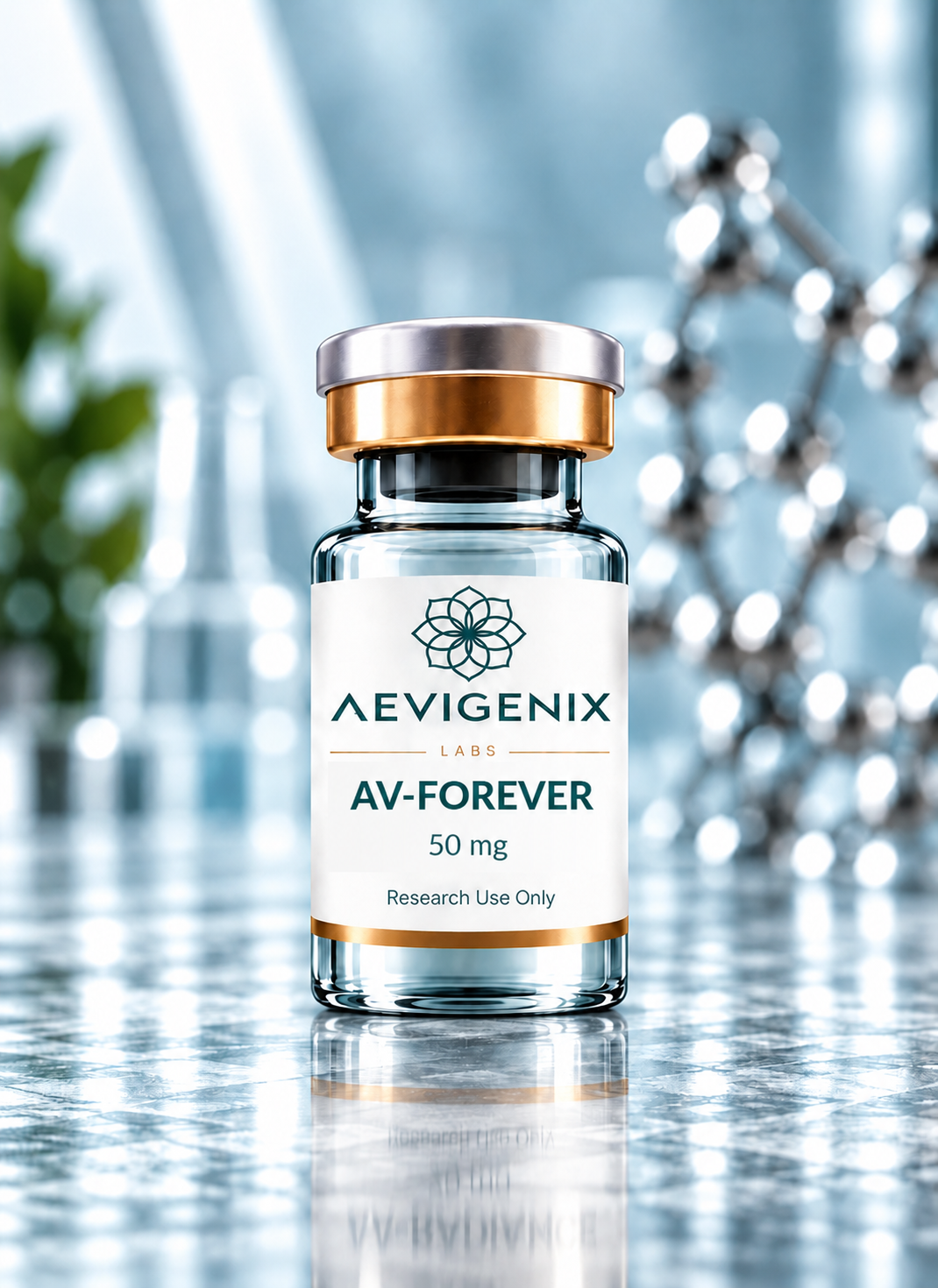
AV-FOREVER | 50 mg Vial
$150.00
Support
Purity & Quality
Within 24 Hours
Canada’s only domestic peptide manufacturer. Ships to every province and territory.
AV-FOREVER contains Epitalon (Epithalon), a synthetic four-amino-acid research peptide with the sequence Ala-Glu-Asp-Gly (AEDG). This defined tetrapeptide is supplied as 50 mg of lyophilized (freeze-dried) powder in a sealed vial for laboratory research.
- A sealed vial containing 50 mg of lyophilized (freeze-dried) Epitalon powder.
- Not included: Laboratory preparation materials and accessories.
Description
AV-FOREVER: Epitalon (Epithalon) Research Peptide
AV-FOREVER contains Epitalon, also spelled Epithalon or Epithalone, a synthetic tetrapeptide consisting of four amino acid residues. Its sequence is Ala-Glu-Asp-Gly (AEDG), and its molecular formula is C14H22N4O9.
The peptide is supplied as 50 mg of lyophilized powder in a sealed vial for nonclinical laboratory research. Epitalon has been investigated in published studies involving cellular processes, telomerase activity and telomere biology.
Epitalon vs. Epithalamin: Understanding the Difference
Although their names are similar, Epitalon and Epithalamin are chemically distinct research materials.
Epithalamin: A polypeptide preparation derived from the pineal gland, containing a mixture of peptide components.
Epitalon: A defined synthetic tetrapeptide consisting of the four-residue sequence Ala-Glu-Asp-Gly (AEDG), developed from research involving the amino acid composition of the pineal preparation.
A 2026 narrative review by Jain and colleagues, published in the International Journal of Molecular Sciences, examined the two materials separately and emphasized their distinct chemical identities and research histories.
View Jain et al. (2026), International Journal of Molecular Sciences
In 2017, researchers at the St. Petersburg Institute of Bioregulation and Gerontology reported identifying the AEDG sequence among tetrapeptides present in the pineal-derived preparation.
View Khavinson et al. (2017), Bulletin of Experimental Biology and Medicine
Epitalon and Telomerase Research
One area of laboratory investigation involving Epitalon concerns telomerase, an enzyme associated with maintaining and extending telomeres, the protective structures located at the ends of chromosomes.
Telomerase activity and telomere regulation are important subjects in cellular biology, including research into cell division, chromosome maintenance and cellular aging processes.
In 2003, Khavinson and colleagues reported experiments involving cultures of human fetal fibroblasts that were ordinarily telomerase-negative.
Following the addition of Epitalon under the experimental conditions, the researchers reported expression of the catalytic subunit of telomerase and detectable telomerase activity in the cultured cells.
View Khavinson et al. (2003), Bulletin of Experimental Biology and Medicine
2025 Research on Telomere Biology
Researchers at Brunel University London published a study in Biogerontology in 2025 investigating Epitalon in several cultured human cell types.
Their work included normal epithelial cells, fibroblasts and two breast cancer cell lines. The investigators evaluated several molecular markers associated with telomere regulation and maintenance.
- Telomere length: Measurement of chromosome-end repeat structures.
- hTERT mRNA: Expression of the gene encoding the catalytic component of human telomerase.
- Telomerase activity: Assessment of enzymatic activity associated with telomere maintenance.
- ALT pathway markers: Indicators associated with alternative lengthening of telomeres, a telomerase-independent maintenance mechanism.
These investigations contribute to the scientific literature on Epitalon’s interactions with cellular systems. However, findings from cell cultures do not independently establish clinical effects or outcomes in living organisms.
View Al-Dulaimi et al. (2025), Biogerontology
Understanding the Published Research
A substantial portion of the published literature naming Epitalon or Epithalon originates from research programs involving Khavinson and colleagues.
A PubMed search conducted on October 17, 2026, illustrates the concentration of publications associated with this research group.
View Epitalon research publications on PubMed
Although these studies provide a foundation for further laboratory investigation, the concentration of research within a relatively small number of collaborating groups is an important consideration when evaluating the available evidence. Published findings also do not independently verify the identity, purity or composition of a specific commercial research vial.
Chemical Identity and Laboratory Documentation
Epitalon is listed in PubChem under CID 219042, with a molecular formula of C14H22N4O9, a molecular weight of approximately 390.35 g/mol and CAS number 307297-39-8.
The PubChem record also includes a second CAS number, 64082-79-7, associated in other chemical reference sources with Epithalamin. Because the two materials are distinct, chemical identity should be confirmed using appropriate analytical documentation rather than relying on names or synonym lists alone.
View Epitalon chemical reference data on PubChem
All peptides are intended exclusively for nonclinical laboratory research. Not for human consumption or veterinary use. Aevigenix does not accept liability for misuse.
| Brand | Aevigenix Research Solutions |
| Product | AV-FOREVER (Epitalon) |
| Alternative Names | Epithalon, Epithalone |
| Format | Lyophilized (freeze-dried) research powder in a sealed vial |
| Quantity | 50 mg per vial (listed quantity; batch verification required) |