
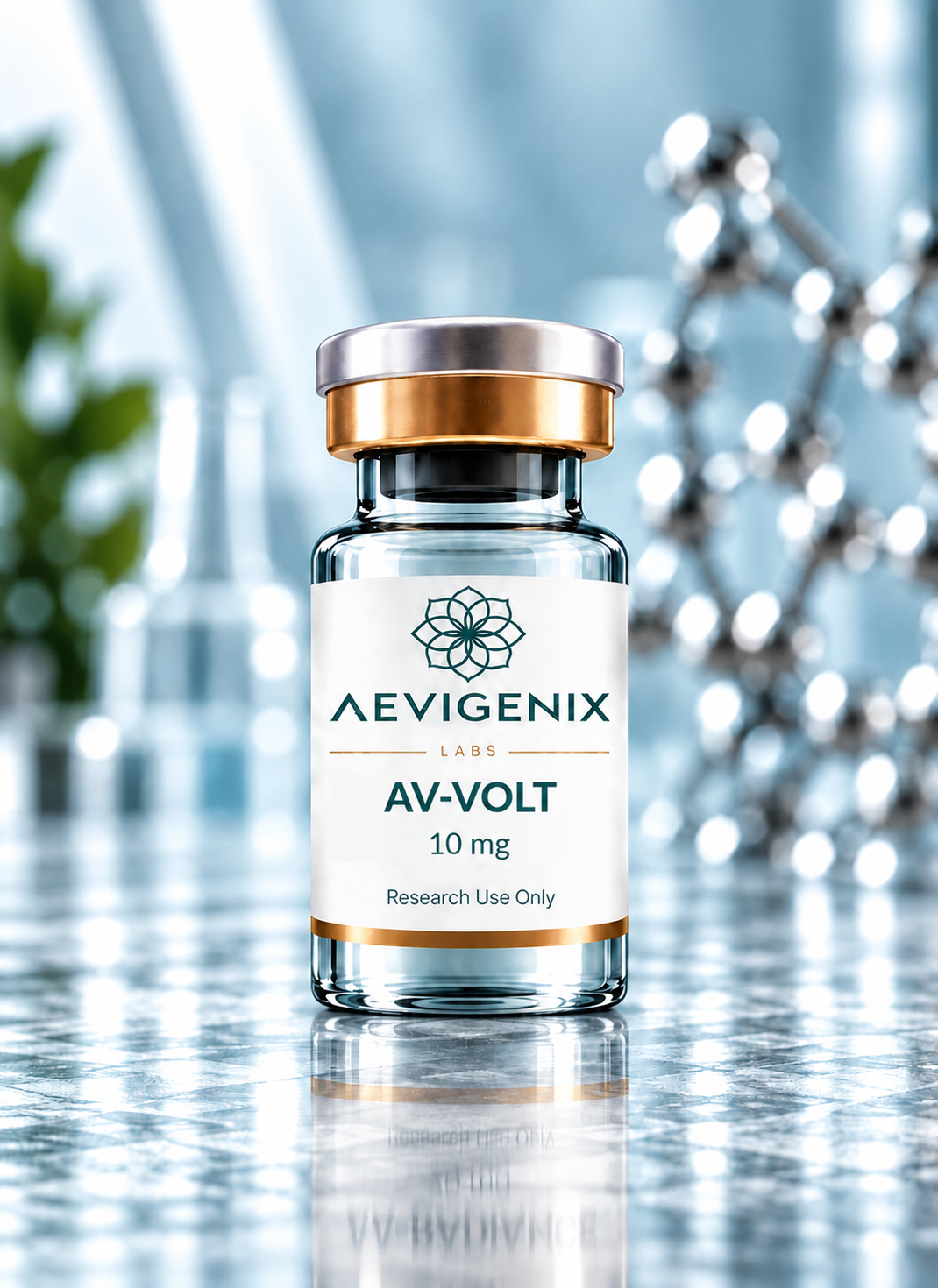
4: AV-VOLT | 10 mg Vial
$85.00
Support
Purity & Quality
Within 24 Hours
Canada’s only domestic peptide manufacturer. Ships to every province and territory.
AV-VOLT contains MOTS-c, a 16-amino-acid research peptide encoded within mitochondrial DNA. This mitochondria-derived peptide is supplied as 10 mg of lyophilized (freeze-dried) powder in a sealed vial for nonclinical laboratory research.
- A sealed vial containing 10 mg of lyophilized (freeze-dried) MOTS-c powder.
- Not included: Laboratory preparation materials and accessories.
Description
AV-VOLT: MOTS-c Mitochondrial Research Peptide
AV-VOLT contains MOTS-c, a 16-amino-acid peptide encoded within mitochondrial DNA. Unlike many synthetic research peptides designed from laboratory-developed sequences, MOTS-c was identified as a naturally encoded peptide associated with a short open reading frame within the mitochondrial 12S ribosomal RNA gene.
The peptide is supplied as 10 mg of lyophilized powder in a sealed vial for nonclinical laboratory research. MOTS-c has been investigated in experimental studies involving mitochondrial signaling, cellular metabolism and gene regulation.
Discovery of MOTS-c
MOTS-c was described in 2015 by Lee and colleagues at the University of Southern California in a publication in Cell Metabolism.
The researchers identified a short open reading frame within the mitochondrial 12S rRNA gene that encodes a peptide consisting of 16 amino acid residues. They named the molecule MOTS-c, short for mitochondrial open reading frame of the 12S rRNA-c.
Their experiments used cultured cells and mouse models to investigate the peptide’s involvement in cellular metabolic pathways.
View Lee et al. (2015), Cell Metabolism
MOTS-c and Cellular Metabolic Research
The original 2015 research examined MOTS-c in relation to the folate cycle and de novo purine synthesis, two interconnected pathways involved in cellular metabolism.
Under the experimental conditions, the investigators reported that MOTS-c inhibited the folate cycle and associated de novo purine synthesis, leading to activation of AMP-activated protein kinase (AMPK).
- Folate cycle: A metabolic pathway involved in one-carbon metabolism.
- De novo purine synthesis: A pathway involved in producing purine nucleotides.
- AMPK signaling: A cellular signaling system associated with energy regulation.
- Skeletal muscle: Identified by the researchers as an apparent principal target tissue in their experimental models.
These findings were generated through preclinical laboratory and animal investigations. They do not establish therapeutic effects in humans or characterize the activity of a specific commercial research preparation.
2018 Research on Nuclear Gene Regulation
In 2018, Kim and colleagues from the same research laboratory published additional findings in Cell Metabolism examining MOTS-c under cellular stress conditions.
The researchers investigated cultured cells subjected to glucose restriction and reported that MOTS-c moved into the cell nucleus under these conditions.
Their findings suggested that MOTS-c participated in the regulation of nuclear gene expression, including genes containing antioxidant response elements, through an AMPK-dependent mechanism.
This work contributed to research on communication between mitochondria and the cell nucleus, a subject often described as mitochondrial-to-nuclear signaling.
View Kim et al. (2018), Cell Metabolism
Current State of Human Research
The published research described in the supplied literature remains predominantly preclinical, with much of the experimental work conducted in cultured cells and animal models.
Some human studies indexed in PubMed have measured naturally circulating MOTS-c levels rather than administering the peptide as an investigational intervention.
View MOTS-c clinical-trial publications on PubMed
As of the October 16, 2026 review date provided in the source material, ClinicalTrials.gov listed a phase 2a placebo-controlled study involving MOTS-c as an intervention, registered in 2026 without posted results at that time.
Clinical trial registrations and publication records may change as new research becomes available.
View ClinicalTrials.gov Study NCT07505745
The source review also reported no MOTS-c product listed in Health Canada’s Drug Product Database as of October 16, 2026. Database status should be checked again when evaluating current regulatory information.
MOTS-c Compared With SS-31
MOTS-c and SS-31 are both discussed in research involving mitochondria, but they are structurally and biologically distinct molecules.
MOTS-c: A 16-amino-acid peptide whose sequence is encoded within mitochondrial DNA.
SS-31: A laboratory-designed four-amino-acid peptide, rather than a peptide encoded by a naturally occurring genomic sequence.
Their association with mitochondrial research does not make the two compounds chemically interchangeable or establish equivalent experimental effects.
Frequently Asked Questions
MOTS-c stands for mitochondrial open reading frame of the 12S rRNA-c. The name was introduced by Lee and colleagues in 2015. MOTS c and MOTSc are alternative spellings of the same peptide designation.
MOTS-c contains 16 amino acid residues with the sequence Met-Arg-Trp-Gln-Glu-Met-Gly-Tyr-Ile-Phe-Tyr-Pro-Arg-Lys-Leu-Arg (MRWQEMGYIFYPRKLR).
AV-VOLT is supplied as 10 mg of lyophilized (freeze-dried) MOTS-c powder in a sealed research vial. This is a dry-powder format, not a premixed solution.
No. Published scientific research describes the molecule and its experimental behavior. Product identity, purity and quantity require batch-specific analytical documentation. The third-party report referenced in the supplied material applies only to its identified 10 mg batch, HS1-MOTS-10-052126, and should not be represented as testing of AV-VOLT without matching documentation.
All peptides are intended exclusively for nonclinical laboratory research. Not for human consumption or veterinary use. Aevigenix does not accept liability for misuse.
| Brand | Aevigenix Research Solutions |
| Product | AV-VOLT (MOTS-c) |