

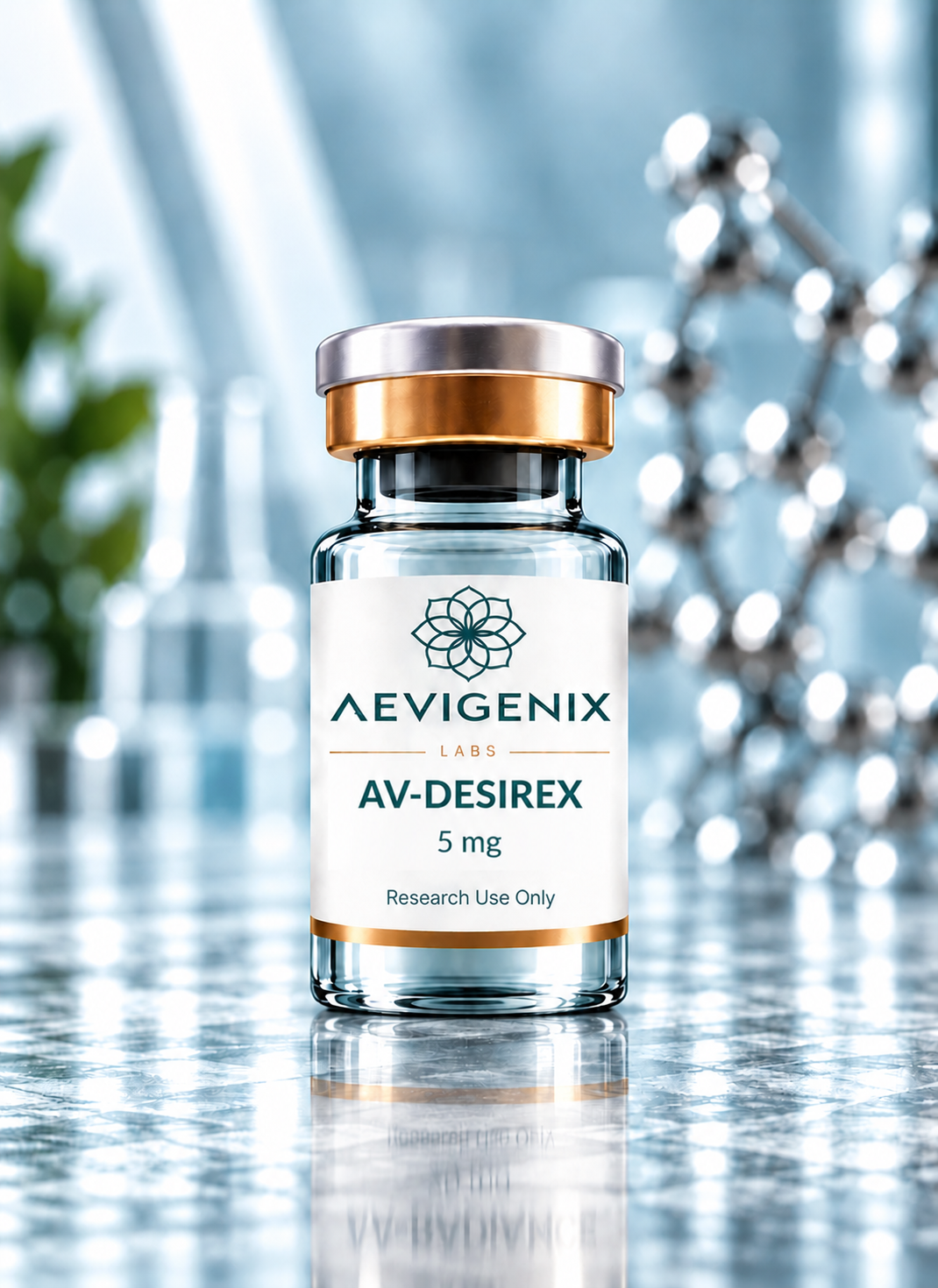
AV-DESIREX | 10 mg Vial
$79.00
Support
Purity & Quality
Within 24 Hours
Canada’s only domestic peptide manufacturer. Ships to every province and territory.
AV-DESIREX contains PT-141 (bremelanotide), a synthetic cyclic heptapeptide from the melanocortin family. This seven-residue research peptide is supplied as 10 mg of lyophilized (freeze-dried) powder in a sealed vial for laboratory research.
- A sealed vial containing 10 mg of lyophilized (freeze-dried) PT-141 powder.
- Not included: Laboratory preparation materials and accessories.
Description
AV-DESIREX: PT-141 (Bremelanotide) Research Peptide
AV-DESIREX contains PT-141, internationally known as bremelanotide, a synthetic cyclic peptide consisting of seven amino acid residues. It belongs to the melanocortin peptide family and is structurally related to melanotan II (MT-2).
The peptide is supplied as 10 mg of lyophilized powder in a sealed vial for nonclinical laboratory research. Its cyclic structure, receptor-binding characteristics and molecular stability have been investigated in published scientific research.
Molecular Structure and Peptide Sequence
PT-141 has the seven-residue sequence Ac-Nle-cyclo[Asp-His-D-Phe-Arg-Trp-Lys]-OH.
- N-terminal modification: Acetyl group attached to L-norleucine (Nle).
- Amino acid configuration: D-phenylalanine at position four.
- Cyclic structure: A side-chain lactam linkage between aspartic acid and lysine.
- C-terminal group: Free carboxylic acid (-OH).
The molecular formula of bremelanotide is C50H68N14O10, with an approximate molecular weight of 1025.2 g/mol and a monoisotopic mass of 1024.52 Da.
View PT-141 chemical reference data on PubChem
PT-141 Compared With Melanotan II (MT-2)
PT-141 and MT-2 share the same cyclic peptide ring and much of their molecular structure. The primary difference lies in the functional group at the C-terminus.
PT-141 terminates in a free carboxylic acid, whereas MT-2 has a carboxamide group. Replacing the terminal amide (-NH2) with a hydroxyl group (-OH) removes one nitrogen and one hydrogen atom while adding one oxygen atom.
| Property | PT-141 | MT-2 |
| C-Terminus | Carboxylic acid | Carboxamide |
| Formula | C50H68N14O10 | C50H69N15O9 |
| Molecular Weight | 1025.2 g/mol | 1024.2 g/mol |
Their monoisotopic masses differ by approximately 0.984 Da. Although closely related, the two molecules are chemically distinct and should not be treated as interchangeable research materials.
Melanocortin Receptor Research
The FDA substance record identifies bremelanotide as an agonist at five melanocortin receptor subtypes, MC1 through MC5, including MC2, which is also known as the ACTH receptor.
View FDA substance reference, UNII 6Y24O4F92S
In 2021, Zhang and colleagues published structural research in Cell Research examining the full-length human melanocortin-4 receptor (MC4R) coupled to its Gs protein.
The investigators reported four receptor structures bound to different ligands, including alpha-MSH, two synthetic peptide analogues (one of which was bremelanotide) and the small molecule THIQ.
Their findings demonstrated a conserved binding mode among the peptide agonists, while the small molecule formed distinct receptor contacts associated with its subtype selectivity.
The bremelanotide-bound MC4R complex was characterized using cryo-electron microscopy at approximately 3.1 angstrom resolution and is available in the Protein Data Bank as structure 7F55.
View Zhang et al. (2021), Cell Research
|
View PDB Structure 7F55
2026 Research on Bremelanotide Stability
Yuvaraaj and Sharma at NIPER Ahmedabad published research in Analytical Methods in 2026 describing a stability-indicating reversed-phase high-performance liquid chromatography (RP-HPLC) method for bremelanotide acetate.
The researchers evaluated the peptide under multiple forced-degradation conditions to characterize its chemical stability and identify degradation pathways.
- Acidic, basic and neutral conditions
- Oxidative stress
- Thermal stress
- Photolytic (light exposure) stress
The study reported lower degradation under acidic conditions than under basic conditions, with pronounced sensitivity to oxidation.
High-resolution LC-MS/MS analysis characterized eight degradation products associated with processes including deacetylation, peptide-bond hydrolysis, oxidation and epimerization.
View Yuvaraaj and Sharma (2026), Analytical Methods
Research Material Identity and Documentation
Bremelanotide is documented in scientific databases in more than one chemical form. PubChem separately lists bremelanotide acetate, with a molecular weight of approximately 1085.2 g/mol.
Without verified batch-specific documentation, the exact chemical form of an individual supplied vial cannot be established solely from the product name or published reference data.
View Bremelanotide Acetate, PubChem CID 91971505
All peptides are for nonclinical laboratory research use only. Not for human consumption or veterinary use. Aevigenix does not accept liability for misuse.
-
New
AV-SHIELD | 10 mg Vial
$150.00 -
New
AV-RADIANCE | Vial
$150.00 -
New
AV-TRIM | 10 mg Vial
$145.00