

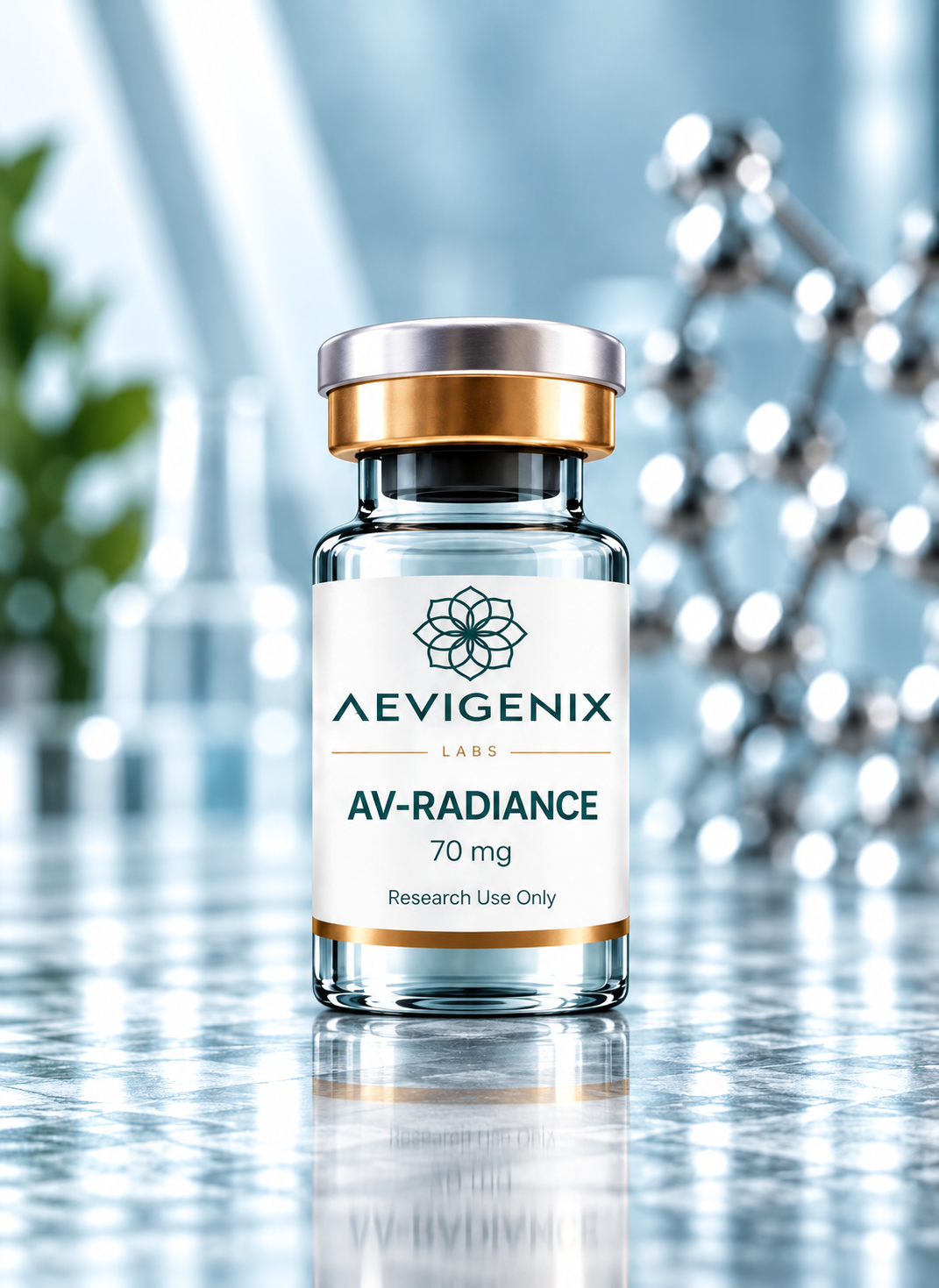
AV-RADIANCE | Vial
$150.00
Support
Purity & Quality
Within 24 Hours
Canada’s only domestic peptide manufacturer. Ships to every province and territory.
Glow, often called the GLOW stack or GLOW blend, combines GHK-Cu, BPC-157 and TB-500 in a 70 mg vial.
- A sealed vial of lyophilized (freeze-dried) powder.
- Not included: Laboratory preparation materials and accessories.
Description
AV-RADIANCE is an Aevigenix Labs branded multi-component synthetic peptide research formulation supplied as a lyophilized (freeze-dried) powder in a 70 mg vial for nonclinical laboratory investigation.
Glow, often called the GLOW stack or GLOW blend, combines GHK-Cu, BPC-157 and a component designated TB-500. These materials are described as freeze-dried together as one powder rather than supplied as separate vials. KPV is not listed as a component.
| Brand | Aevigenix Labs |
| Product | AV-RADIANCE (GLOW Blend) |
| Format | Lyophilized research vial |
| Contents | GHK-Cu, BPC-157 and TB-500 designation, freeze-dried together as one powder; no KPV listed |
| Total Quantity | 70 mg per vial (listed total; batch verification required) |
| GHK-Cu | Gly-His-Lys bound to copper(II); approximately 402.92 g/mol for PubChem’s referenced 1:1 complex. PubChem CID 71587328 |
| BPC-157 | 15-residue peptide; approximately 1419.5 g/mol. PubChem CID 9941957 |
| TB-500 | PubChem describes a 7-residue acetylated peptide fragment with a molecular mass of approximately 889.0 g/mol. PubChem CID 62707662. Identity of the supplied component requires verification. |
| Storage | Keep sealed, dry and protected from light. Proposed long-term storage range of −20°C to −80°C requires supplier confirmation. |
| Purity / Identity | Refer to verified batch-specific Certificate of Analysis (COA) and supplier documentation |
Component molecular values are PubChem reference data, not specifications for an individual production lot. The listed 70 mg quantity represents the total vial content, not a verified per-peptide breakdown.
Of GLOW’s three peptides, TB-500 is the one whose name is least settled. Thymosin β4 is a 43-residue protein with a molecular mass of approximately 4963 g/mol (PubChem CID 16132341, listed as timbetasin). Safer, Elzinga and Nachmias (J Biol Chem, 1991) sequenced an actin-sequestering peptide from human platelets, found it identical to thymosin β4, and showed that it binds actin monomers one to one.
TB-500 names something much smaller. A doping-control laboratory at Ghent University analysed a product sold as TB-500 by liquid chromatography with high-resolution mass spectrometry and identified Ac-LKKTETQ, the N-acetylated 17–23 fragment of thymosin β4 (Esposito et al., Drug Testing and Analysis, 2012). PubChem files TB-500 under that fragment. No supplied batch certificate establishes which of these materials is present in this AV-RADIANCE vial.
The evidence on the combination is thin. Curtis’s research review reports that a PubMed search for records naming BPC-157, TB-500 or thymosin β4, and GHK together returned only a few records as of October 16, 2026, all general reviews. No experimental study of the three combined was identified in that review.
Product identity, individual component quantities, purity and batch-specific analytical information should be verified against the applicable supplier documentation and Certificate of Analysis (COA).
Published molecular weights and chemical descriptions provide scientific reference information. They should not be interpreted as proof of the identity, purity or composition of a particular Aevigenix production batch.
GHK-Cu, BPC-157 and TB-500: Chemical Reference Data
The individual components have different chemical structures and molecular characteristics. Published reference data do not establish the precise composition of this combined vial.
Thymosin β4 and TB-500: Research Background
The 1991 study by Safer, Elzinga and Nachmias characterized thymosin β4 as an actin-binding peptide. A separate 2012 analytical study identified the N-acetylated 17–23 fragment in a commercial sample sold as TB-500.
These findings describe different scientific materials and do not independently verify the identity of the TB-500-designated component supplied in AV-RADIANCE.
Research on the Combined GLOW Formulation
The published literature concerning GHK-Cu, BPC-157 and TB-500 or thymosin β4 as a combined formulation is limited. The properties of the individual components should not be assumed to establish the properties of their combination.
FOR NONCLINICAL LABORATORY RESEARCH ONLY.
NOT FOR HUMAN OR VETERINARY USE.
This product is not intended for human consumption, self-administration, veterinary administration, diagnostic applications, treatment or prevention of disease. Product information is provided for scientific identification and laboratory research context only. Research Use Only labeling does not establish regulatory authorization for sale or use.
| Brand | Aevigenix Research Solutions |
| Product | AV-RADIANCE (GLOW Blend) |
| Format | Lyophilized research vial |
| Contents | GHK-Cu, BPC-157 and TB-500 designation, freeze-dried together as one powder; no KPV listed |
| Total Quantity | 70 mg per vial (listed total; batch verification required) |
| GHK-Cu | Gly-His-Lys bound to copper(II); approximately 402.92 g/mol for PubChem's referenced 1:1 complex. PubChem CID 71587328 |
| BPC-157 | 15-residue peptide; approximately 1419.5 g/mol. PubChem CID 9941957 |
| TB-500 | PubChem describes a 7-residue acetylated peptide fragment with a molecular mass of approximately 889.0 g/mol. PubChem CID 62707662. Identity of the supplied component requires verification. |
| Storage | Keep sealed, dry and protected from light. Proposed long-term storage range of −20°C to −80°C requires supplier confirmation. |
| Purity / Identity | Refer to verified batch-specific Certificate of Analysis (COA) and supplier documentation |
Component molecular values are PubChem reference data, not specifications for an individual production lot. The listed 70 mg quantity represents the total vial content, not a verified per-peptide breakdown.
-
New
AV-LEAN | 10 mg Vial
$145.00 -
New
4: AV-VOLT | 10 mg Vial
$85.00 -
New
AV-RESTORE | 5 mg Vial
$69.50