
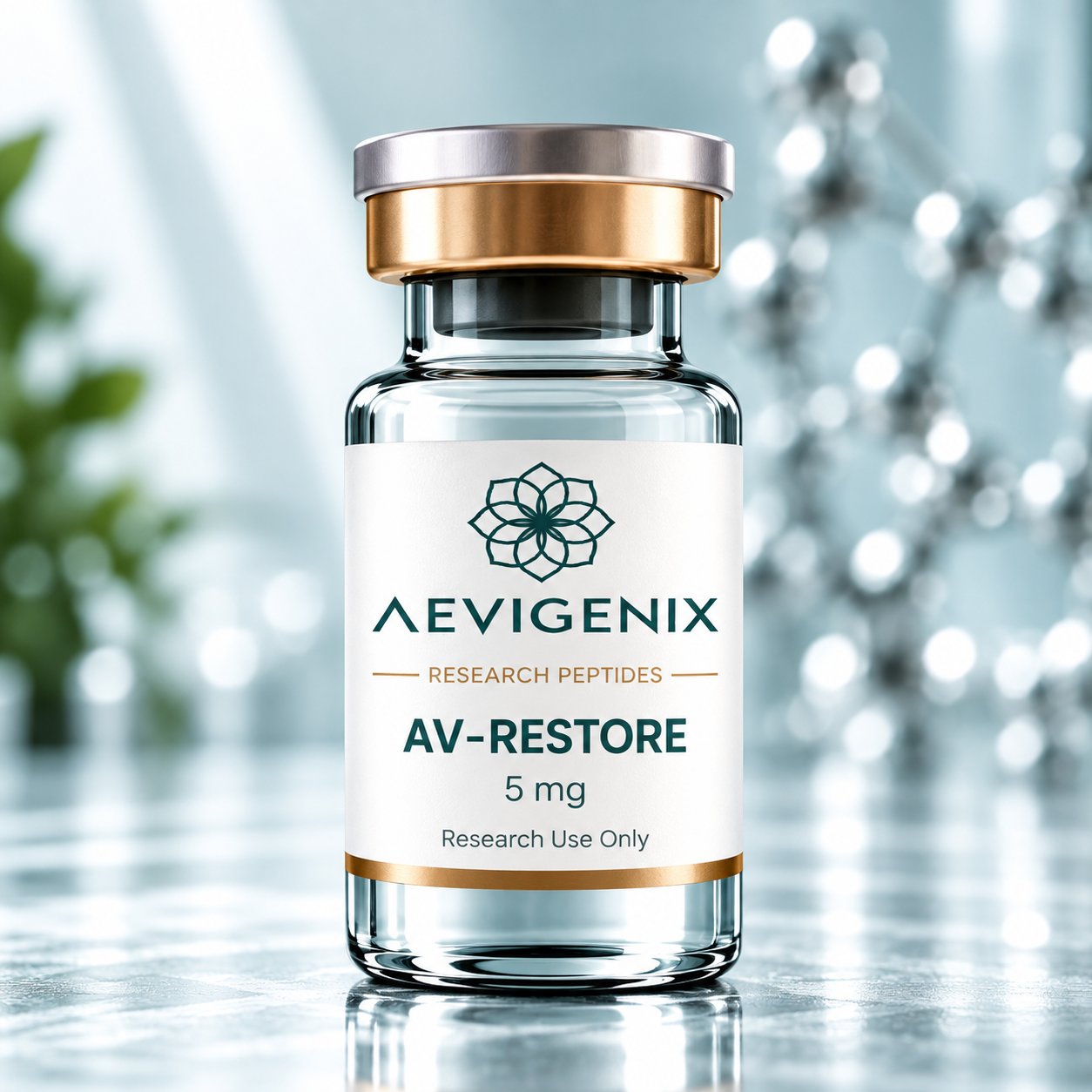
AV-RESTORE | 5 mg Vial
$69.50
Support
Purity & Quality
Within 24 Hours
Canada’s only domestic peptide manufacturer. Ships to every province and territory.
AV-RESTORE contains DSIP (Delta Sleep-Inducing Peptide), also known as emideltide, a nine-amino-acid research peptide with the sequence Trp-Ala-Gly-Gly-Asp-Ala-Ser-Gly-Glu. Supplied as 5 mg of lyophilized (freeze-dried) powder in a sealed vial for laboratory research.
- A sealed vial containing 5 mg of lyophilized (freeze-dried) DSIP powder.
- Not included: Laboratory preparation materials and accessories.
Description
AV-RESTORE: DSIP (Delta Sleep-Inducing Peptide) Research Peptide
AV-RESTORE contains DSIP, short for Delta Sleep-Inducing Peptide, a synthetic nine-residue peptide also known by the international nonproprietary name emideltide.
The peptide has the amino acid sequence Trp-Ala-Gly-Gly-Asp-Ala-Ser-Gly-Glu (WAGGDASGE) and is supplied as 5 mg of lyophilized powder in a sealed vial for nonclinical laboratory research.
The Discovery and Naming of DSIP
DSIP was first isolated and characterized in research conducted by Schoenenberger, Monnier and colleagues in Basel, Switzerland, in 1977.
The researchers isolated the peptide from rabbits, determined its nine-amino-acid sequence and synthesized the molecule alongside five possible degradation fragments and two analogues containing exchanged amino acid residues.
The term “delta” refers to delta-wave activity measured using electroencephalography (EEG) in the original rabbit experiments. The name reflects the historical research context rather than an established biological function of the peptide.
View Schoenenberger and Monnier (1977), PNAS
Scientific Review of the DSIP Hypothesis
Despite its name, the proposed relationship between DSIP and sleep regulation has not been conclusively established.
In 2006, Kovalzon and Strekalova published a review in the Journal of Neurochemistry examining the historical evidence surrounding DSIP, including its reported isolation from rabbit cerebral venous blood.
The authors described the original hypothesis behind the peptide’s name as poorly documented. They also noted that, at the time of their review, no corresponding gene, precursor protein or receptor had been isolated, and that the peptide’s structure did not resemble any other established peptide family.
View Kovalzon and Strekalova (2006), Journal of Neurochemistry
Research on DSIP Stability and Degradation
Laboratory studies have also examined how DSIP behaves when exposed to biological materials.
In 1987, Graf and colleagues investigated DSIP degradation in human and rat blood. Their experiments identified degradation products exhibiting chromatographic behavior similar to free tryptophan during gel filtration.
The observed degradation rates varied according to incubation temperature, duration and species. Two modified peptide analogues, including a phosphorylated form, demonstrated slower degradation under the experimental conditions.
View Graf et al. (1987), Peptides
Molecular Structure and Peptide Conformation
A 1994 investigation conducted at the University of Kansas examined the structural behavior of DSIP in solution using several analytical techniques.
- Nuclear magnetic resonance (NMR) spectroscopy
- Circular dichroism spectroscopy
- Infrared spectroscopy
- Fluorescence spectroscopy
The researchers observed that DSIP in solution transitions between relatively unordered and folded molecular conformations.
Their findings indicated that amino acid residues 2–5 and 6–9 showed tendencies toward type I beta-turn structures, contributing to the understanding of the peptide’s conformational behavior.
View Gray et al. (1994), Biochemistry
Laboratory Material and Research Considerations
AV-RESTORE is supplied in lyophilized form. Freeze-drying is commonly used in peptide preparation to reduce exposure to water during storage and transportation.
The DSIP sequence begins with tryptophan, an amino acid residue that can be susceptible to oxidation under certain solution conditions. Appropriate handling and storage conditions are therefore relevant to laboratory investigations involving peptide stability.
The cited scientific studies describe DSIP as a research molecule and do not independently establish the identity, purity or stability of any individual commercial vial. Batch-specific analytical documentation is required to evaluate supplied material.
All peptides are for nonclinical laboratory research use only. Not for human consumption or veterinary use. Aevigenix does not accept liability for misuse.
| Brand | Aevigenix Research Solutions |
| Product | AV-RESTORE (DSIP) |
| Scientific Name | Delta Sleep-Inducing Peptide |
| International Nonproprietary Name | Emideltide |
| Format | Lyophilized (freeze-dried) research powder in a sealed vial |
| Quantity | 5 mg per vial (listed quantity; batch verification required) |
| Amino Acid Sequence | Trp-Ala-Gly-Gly-Asp-Ala-Ser-Gly-Glu (WAGGDASGE) |
| Peptide Length | 9 amino acid residues |
| C-Terminus | Free carboxylic acid |
| Molecular Formula | <td style="padding:11px 0;color:#164F52;vertical-align: