

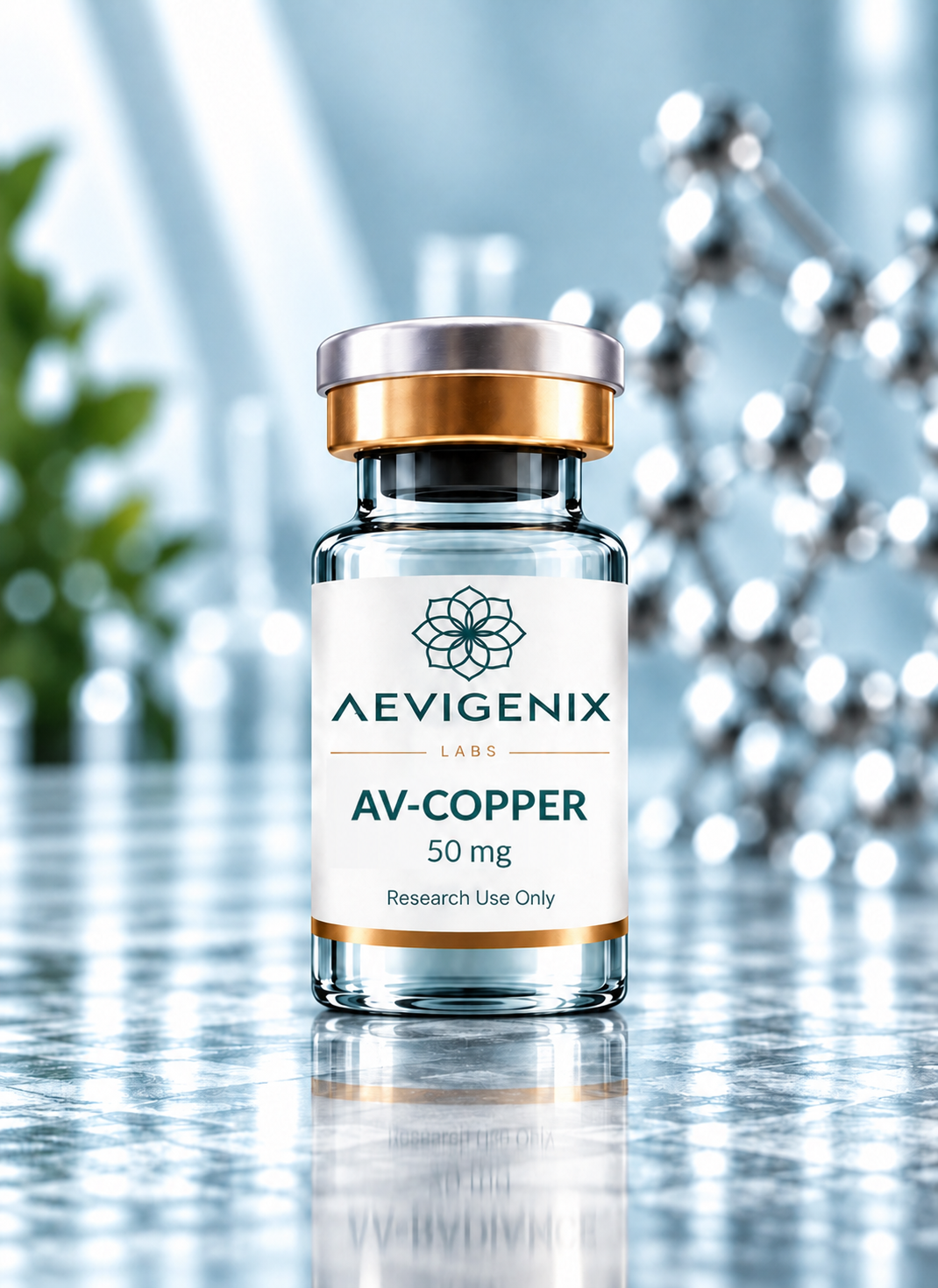
AV-COPPER | 50 mg Vial
$80.00
Support
Purity & Quality
Within 24 Hours
Canada’s only domestic peptide manufacturer. Ships to every province and territory.
AV-COPPER contains GHK-Cu, also known as Copper Tripeptide-1 or Pre zatide Copper, a copper-binding research peptide composed of glycine, histidine and lysine complexed with copper(II). Supplied as 50 mg of lyophilized (freeze-dried) powder in a sealed research vial.
- A sealed vial containing 50 mg of lyophilized (freeze-dried) GHK-Cu powder.
- Not included: Laboratory preparation materials and accessories.
Description
AV-COPPER: GHK-Cu (Copper Tripeptide-1) Research Peptide
AV-COPPER contains GHK-Cu, a copper-binding tripeptide composed of the amino acids glycine, histidine and lysine. The peptide is also identified in chemical reference databases as Copper Tripeptide-1 and Pre zatide Copper.
GHK-Cu is formed when the tripeptide GHK binds copper(II). The compound has been investigated in laboratory studies involving copper coordination chemistry, molecular structure and cultured cell systems. AV-COPPER is supplied as 50 mg of lyophilized powder in a sealed research vial.
Understanding GHK and GHK-Cu
GHK is the three-amino-acid peptide glycyl-L-histidyl-L-lysine. Its sequence is represented by the one-letter amino acid codes G-H-K.
When this peptide coordinates with copper(II), it forms a copper-peptide complex commonly referred to as GHK-Cu.
GHK (without copper): Molecular formula C14H24N6O4, with a molecular weight of approximately 340.38 g/mol.
GHK-Cu (1:1 complex): Molecular formula C14H23CuN6O4+, with a molecular weight of approximately 402.92 g/mol.
GHK-Cu (2:1 complex): A separately documented peptide-to-copper complex with a molecular weight of approximately 742.3 g/mol.
These molecular values describe reference chemical species. They do not independently establish the copper coordination ratio, salt form or purity of an individual commercial research vial.
GHK Reference, PubChem CID 73587
|
GHK-Cu Reference, PubChem CID 71587328
Early Research on Copper Binding
GHK is a tripeptide identified in plasma, and its copper-binding characteristics have been studied using laboratory chemical methods.
In 1981, Lau and Sarkar published research in the Biochemical Journal examining copper coordination by GHK using potentiometry and visible-absorption spectrophotometry.
Their equilibrium dialysis experiments at pH 7.5 included albumin and GHK at equal concentrations. Under those conditions, approximately 42% of the copper(II) was bound to the peptide.
This was a controlled binding measurement in a laboratory buffer system, not an observation of copper distribution in a living organism.
View Lau and Sarkar (1981), Biochemical Journal
Molecular Structure and Copper Coordination
In 2011, Hureau and colleagues investigated the molecular structure of GHK-Cu using X-ray crystallography and spectroscopic techniques.
The researchers reported different structural arrangements depending on the experimental environment: a dimeric structure in the solid state and a monomeric structure in solution.
The researchers identified coordination involving three principal chemical groups:
- The terminal amino group
- An amide nitrogen
- The imidazole group of histidine
The study also associated rapid copper exchange behavior with the formation of a 2:1 peptide-to-copper species.
View Hureau et al. (2011), Chemistry
GHK-Cu in Cell Culture Research
GHK-Cu has also been investigated in experimental cell culture systems.
In 1988, Maquart and colleagues published research in FEBS Letters examining GHK-Cu in fibroblast cultures.
The investigators reported increased collagen synthesis under their experimental conditions, without a corresponding change in the number of cultured cells.
These findings were obtained from an individual in vitro study and should not be interpreted as establishing clinical effects or outcomes in humans.
View Maquart et al. (1988), FEBS Letters
Review of GHK-Cu Research
In 2018, Pickart and Margolina published a narrative review in the International Journal of Molecular Sciences summarizing research involving GHK-Cu.
The review discussed experimental findings from cell cultures, animal investigations and gene-expression analyses, including work involving the Broad Institute’s Connectivity Map.
The publication is a narrative review rather than a systematic review. Both authors were affiliated with R&D Skin Biology, an important consideration when evaluating the scope and independence of the available literature.
View Pickart and Margolina (2018), International Journal of Molecular Sciences
Frequently Asked Questions
G, H and K are the one-letter amino acid codes for glycine, histidine and lysine. Cu is the chemical symbol for copper. GHKCu and GHK Cu are alternative spellings of the same designation.
Yes. Copper Tripeptide-1 is a cosmetic ingredient designation associated with GHK-Cu. PubChem also lists prezatide copper as a synonym under CID 71587328. The broader term “copper peptide” can describe other compounds, including AHK-Cu.
GHK refers to the tripeptide without copper, with a molecular weight of approximately 340.38 g/mol. GHK-Cu refers to a copper(II)-bound form of the peptide. AV-COPPER is listed as GHK-Cu research material.
No. AV-COPPER is lyophilized research material supplied in a sealed 50 mg vial. GHK-Cu face creams are finished cosmetic formulations and are separate product types.
No. Aevigenix supplies GHK-Cu strictly for qualified laboratory, analytical or educational research and does not provide human or veterinary administration guidance.
All peptides are intended exclusively for nonclinical laboratory research. Not for human consumption or veterinary use. Aevigenix does not accept liability for misuse.
| Brand | Aevigenix Research Solutions |
| Product | AV-COPPER (GHK-Cu) |
| Alternative Names | Copper Tripeptide-1, Pre zatide Copper, GHKCu, GHK Cu |
| Peptide Classification | Copper-binding tripeptide complex |
| Format | Lyophilized (freeze-dried) research powder in a sealed vial |
| Quantity | 50 mg per vial (listed quantity; batch verification required) |
| Amino Acid Sequence | Gly-His-Lys (GHK), glycyl-L-histidyl-L-lysine |
| Peptide Length | 3 amino acid residues |
| GHK Without Copper | C14H24N6O4; approximately 340.38 g/mol; CAS 49557-75-7. PubChem CID 73587 |
| GHK-Cu (1:1 Complex) | C14H23CuN6O4+; approximately 402.92 g/mol; CAS 89030-95-5. PubChem CID 71587328 |
| GHK-Cu (2:1 Complex) | Two peptide molecules coordinated with one copper ion; approximately 742.3 g/mol. PubChem CID 9831891 |
| Copper Coordination | Terminal amino group, amide nitrogen and histidine imidazole group, as described in published structural research |
| Storage | Keep sealed, dry and protected from light. General proposed long-term storage range: −20°C to −80°C; supplier confirmation required. |
| Purity / Identity | Refer to verified batch-specific Certificate of Analysis (COA) and supplier documentation for copper complex identity, salt form, purity and quantity. |
The molecular formulas and weights shown above are published chemical reference values, not verified specifications for an individual production lot. The supplied copper complex ratio and salt form require confirmation through batch-specific documentation.
-
New
AV-DESIREX | 10 mg Vial
$79.00 -
New
AV-LEAN | 10 mg Vial
$145.00 -
New
AV-RADIANCE | Vial
$150.00