

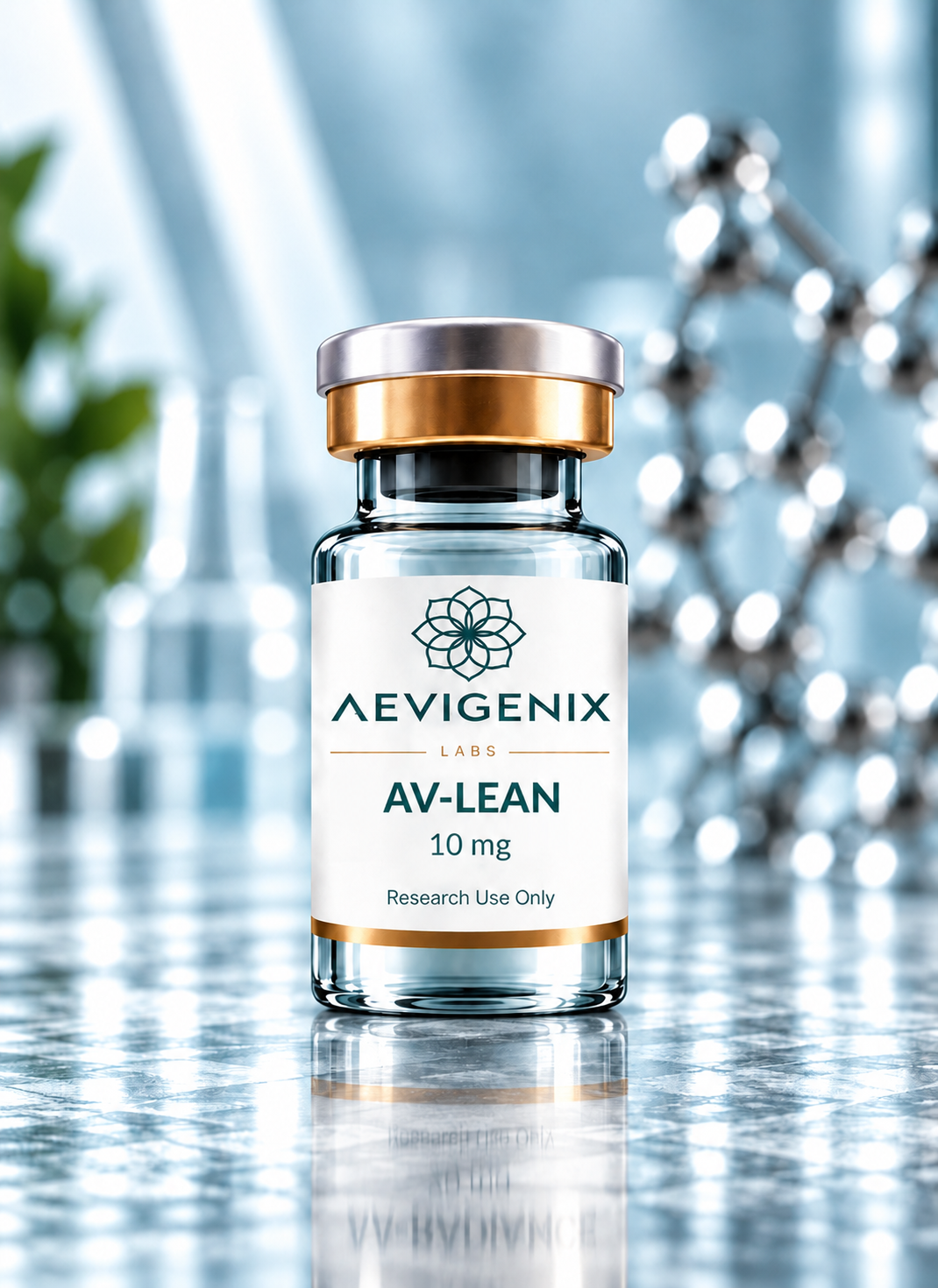
AV-LEAN | 10 mg Vial
$145.00
Support
Purity & Quality
Within 24 Hours
Canadian peptide research materials. Shipping available to every province and territory.
AV-LEAN contains TH9507, a synthetic 44-amino-acid analogue of human growth hormone-releasing hormone (GHRH). Featuring a trans-3-hexenoyl modification at its amino terminus, this research peptide is supplied as 10 mg of lyophilized (freeze-dried) powder in a sealed vial for nonclinical laboratory research.
- A sealed vial containing 10 mg of lyophilized (freeze-dried) TH9507 research powder.
- Not included: Laboratory preparation materials and accessories.
Description
AV-LEAN: TH9507 (GHRH Analogue) Research Peptide
AV-LEAN is a research peptide formulation identified by the development code TH9507. The compound is a synthetic analogue of human growth hormone-releasing hormone (GHRH).
TH9507 retains the full 44-amino-acid sequence of human growth hormone-releasing factor while incorporating a trans-3-hexenoyl group at its amino terminus. This structural modification distinguishes the synthetic analogue from the naturally occurring hormone.
The Discovery of Human Growth Hormone-Releasing Factor
The naturally occurring hormone that served as the foundation for TH9507 was characterized in 1982.
In November of that year, Guillemin and colleagues published research in Science describing a 44-amino-acid growth hormone-releasing factor with a C-terminal amide group.
This 44-residue chain forms the structural foundation of TH9507, which retains the sequence while incorporating an additional modification at the amino terminus.
View Guillemin et al. (1982), Science
During the same year, Spiess and colleagues reported a related 40-residue free-acid form of growth hormone-releasing factor.
Their research also examined shorter synthetic peptide sequences, including a 1–29 amide fragment, which demonstrated comparable activity to the longer peptide in their in vitro assays.
View Spiess et al. (1982), Biochemistry
Why the Amino Terminus Matters
Research into naturally occurring growth hormone-releasing factor identified the amino-terminal region as an important site of enzymatic degradation.
In 1986, Frohman and colleagues investigated the stability of the 44-residue hormone following incubation in human plasma.
The researchers traced degradation to a dipeptidylaminopeptidase that removed the first two amino acid residues, tyrosine and alanine (Tyr-Ala), from the peptide’s amino terminus.
The resulting 3–44 peptide fragment retained less than one-thousandth of the original hormone’s activity under the experimental conditions, illustrating the importance of the amino-terminal sequence to the molecule’s measured activity.
View Frohman et al. (1986), Journal of Clinical Investigation
TH9507 Structural Modification
TH9507 was developed with a targeted modification intended to address the susceptibility of the natural hormone’s amino terminus to enzymatic breakdown.
The molecule retains the human growth hormone-releasing factor 1–44 amide sequence, with a trans-3-hexenoyl group attached to the first amino acid residue, tyrosine.
- Peptide backbone: Full 44-residue human GHRH sequence.
- N-terminal modification: (3E)-hex-3-enoyl (trans-3-hexenoyl) group attached to Tyr1.
- C-terminus: Amidated leucine residue (leucinamide).
- Development designation: TH9507.
2007 Research on Enzymatic Stability
Ferdinandi and colleagues published research in Basic & Clinical Pharmacology & Toxicology in 2007 describing the synthetic GHRH analogue under the development designation TH9507.
The investigators characterized the molecule as hGRF(1–44)-NH2 with a trans-3-hexenoyl modification at the first tyrosine residue.
Their experiments reported resistance to deactivation by dipeptidyl aminopeptidase-IV and slower in vitro degradation compared with the natural hormone in rat, dog, and human plasma.
The publication also included animal pharmacology and toxicology investigations, providing additional preclinical characterization of the synthetic analogue.
View Ferdinandi et al. (2007), Basic & Clinical Pharmacology & Toxicology
Chemical Identity and Research Documentation
The investigational compound identified as TH9507 is listed in PubChem under CID 16137828, with the molecular formula C221H366N72O67S, an approximate computed molecular weight of 5136 g/mol, and CAS number 218949-48-5.
The FDA substance record identifies the same compound under UNII MQG94M5EEO and documents its peptide sequence and terminal modifications.
An acetate salt form is separately identified in regulatory substance records. Without verified batch-specific documentation, the exact chemical or salt form of an individual research vial cannot be established solely from its product designation.
View Compound Record on PubChem
|
All peptides are intended exclusively for nonclinical laboratory research. Not for human consumption, administration, or veterinary use. Purchasers are responsible for lawful handling and compliance with applicable regulations.
| Brand | Aevigenix Research Solutions |
| Product | AV-LEAN (TH9507) |
| Research Designation | TH9507 |
| Peptide Classification | Synthetic analogue of human growth hormone-releasing hormone (GHRH) |
| Format | Lyophilized (freeze-dried) research powder in a sealed vial |
| Quantity | 10 mg per vial |
| Peptide Length | 44 amino acid residues |
| Structural Modification | N-terminal trans-3-hexenoyl modification |
| Molecular Formula | C221H366N72O67S (reference compound) |
| Molecular Weight | Approximately 5,136 g/mol (reference compound) |
| CAS Number | 218949-48-5 (reference compound) |
| PubChem CID | 16137828 |
| FDA UNII | MQG94M5EEO |
| Research Application | Nonclinical laboratory research |
| Batch Documentation | Refer to verified batch-specific analytical documentation |
AV-LEAN is supplied exclusively for nonclinical laboratory research. Not for human consumption, administration, or veterinary use. Molecular identifiers and chemical characteristics refer to the published reference compound and do not independently verify the composition or purity of an individual production lot.
View Full Terms of Use-
New
AV-DESIREX | 10 mg Vial
$79.00 -
New
AV-RESTORE | 5 mg Vial
$69.50 -
New
AV-COPPER | 50 mg Vial
$80.00