
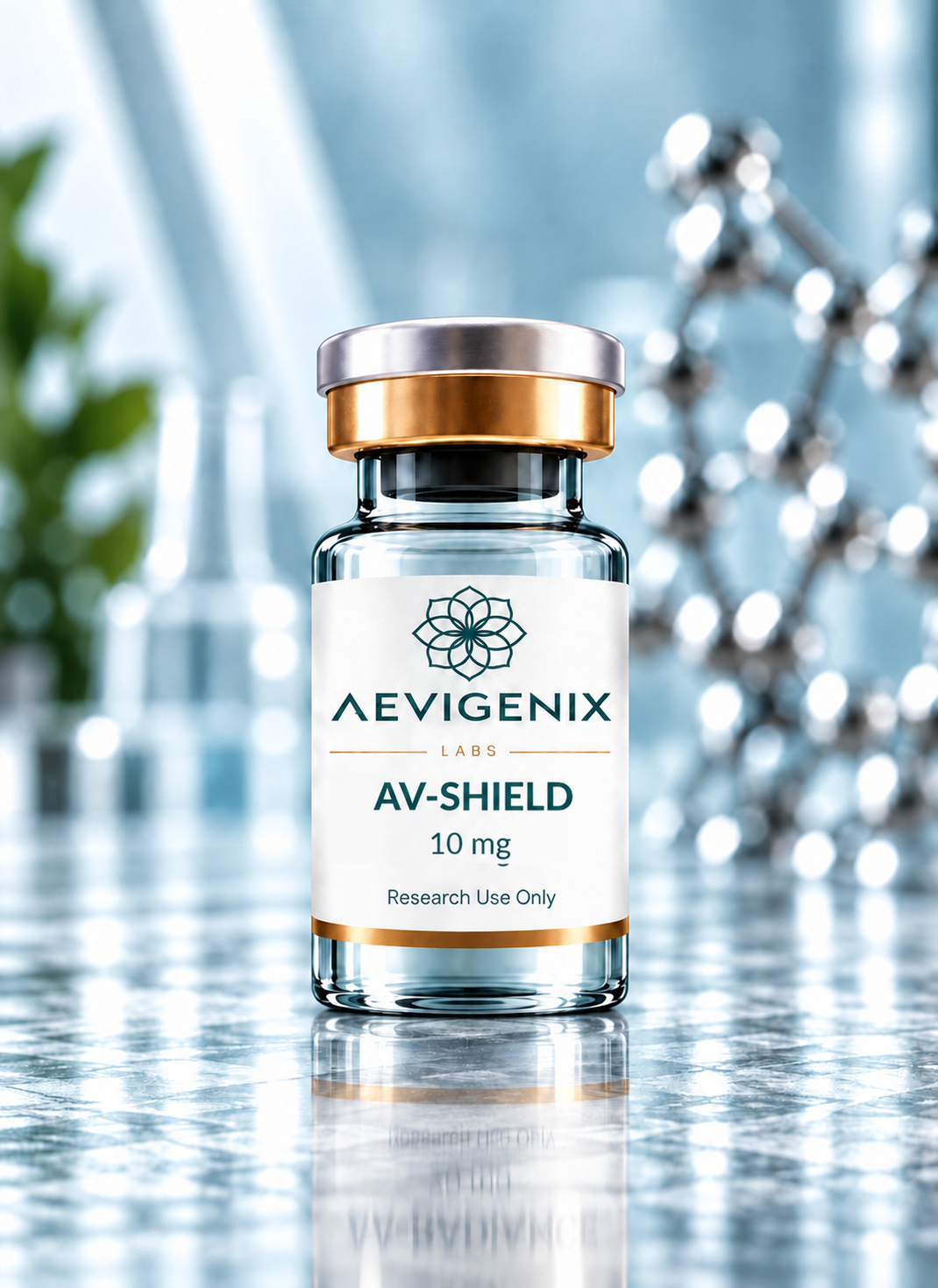
AV-SHIELD | 10 mg Vial
$150.00
Support
Purity & Quality
Within 24 Hours
Canada’s only domestic peptide manufacturer. Ships to every province and territory.
AV-SHEILD contains Thymosin Alpha-1 (Thymalfasin), a synthetic 28-amino-acid research peptide featuring an acetylated serine at its N-terminus. Supplied as 10 mg of lyophilized (freeze-dried) powder in a sealed vial for nonclinical laboratory research.
- A sealed vial containing 10 mg of lyophilized (freeze-dried) Thymosin Alpha-1 powder.
- Not included: Laboratory preparation materials and accessories.
Description
AV-SHEILD: Thymosin Alpha-1 (Thymalfasin) Research Peptide
AV-SHEILD contains Thymosin Alpha-1, also known by its international nonproprietary name Thymalfasin, a synthetic peptide composed of 28 amino acid residues.
Thymosin Alpha-1 is characterized by an acetylated serine at its amino terminus, a free carboxylic acid at its C-terminus and a relatively high proportion of acidic amino acid residues. It is supplied as 10 mg of lyophilized powder in a sealed vial for laboratory research.
Discovery of Thymosin Alpha-1
Thymosin Alpha-1 was originally isolated from thymosin fraction 5, a preparation extracted from calf thymus tissue.
In 1977, Goldstein and colleagues published research in the Proceedings of the National Academy of Sciences describing the isolation and amino acid sequence of the peptide.
Their investigation identified Thymosin Alpha-1 as a heat-stable, highly acidic polypeptide consisting of 28 amino acid residues. The publication also proposed a naming system for the family of polypeptides identified within thymosin fraction 5.
View Goldstein et al. (1977), PNAS
Chemical Structure and Amino Acid Composition
Thymosin Alpha-1 has a defined 28-residue amino acid sequence, beginning with an acetylated serine residue and ending with a free carboxylic acid.
Ac-SDAAVDTSSEITTKDLKEKKEVVEEAEN-OH
Peptide length: 28 amino acid residues
N-terminus: Acetylated serine
C-terminus: Free carboxylic acid
Molecular weight: Approximately 3108.3 g/mol
Nine of the peptide’s 28 amino acid residues are aspartic acid or glutamic acid, compared with four lysine residues. This contributes to the peptide’s acidic chemical characteristics.
In 1979, Low and Goldstein reported an isoelectric point of approximately 4.2 and confirmed the presence of acetylserine at the amino terminus.
View Low and Goldstein (1979), Journal of Biological Chemistry
Synthetic and Naturally Isolated Thymosin Alpha-1
The 1979 research also compared chemically synthesized Thymosin Alpha-1 with the peptide isolated from thymosin fraction 5.
The investigators reported that the synthetic peptide behaved similarly to the naturally isolated material in their experimental assays, contributing to the chemical characterization of the 28-residue sequence.
The same publication examined another component of thymosin fraction 5, designated polypeptide beta-1, and identified its sequence as identical to ubiquitin.
This finding demonstrated that the naming system applied to thymosin fraction 5 components reflected their isolation from a shared preparation, rather than necessarily indicating close structural relationships between the peptides.
Prothymosin Alpha and the Natural Peptide
Subsequent research raised questions about whether free Thymosin Alpha-1 naturally occurs as an independent peptide within thymus tissue.
In 1984, Haritos, Goodall and Horecker isolated a larger polypeptide from rat thymus containing approximately 112 amino acid residues.
The researchers identified the Thymosin Alpha-1 sequence at the amino-terminal end of this larger molecule, which they named prothymosin alpha.
- A larger polypeptide of approximately 112 residues was isolated from rat thymus.
- The Thymosin Alpha-1 sequence was identified at its amino-terminal region.
- Free Thymosin Alpha-1 was not detected in the examined thymus extracts.
- The authors proposed that smaller thymosin fragments may arise during preparation and isolation procedures.
The researchers proposed that prothymosin alpha may represent the native polypeptide and that Thymosin Alpha-1 and other fragments could be generated during the isolation of thymosin fraction 5.
View Haritos, Goodall and Horecker (1984), PNAS
Research Material Identity and Documentation
Thymosin Alpha-1 is listed in PubChem under CID 16130571, with the molecular formula C129H215N33O55, an approximate molecular weight of 3108.3 g/mol and CAS number 62304-98-7.
The PubChem record includes synonyms associated with human and bovine peptide forms, as well as an acetate designation.
These chemical reference values do not independently establish the salt form, identity or purity of an individual production lot. Appropriate batch-specific analytical documentation is required to verify the supplied research material.
View Thymosin Alpha-1 chemical reference data on PubChem
All peptides are intended exclusively for nonclinical laboratory research. Not for human consumption or veterinary use. Aevigenix does not accept liability for misuse.
| Brand | Aevigenix Research Solutions |
| Product | AV-SHEILD (Thymosin Alpha-1) |
| Alternative Names | Thymosin Alpha-1, Thymosin Alpha1, Thymalfasin (INN/USAN) |
| Format | Lyophilized (freeze-dried) research powder in a sealed vial |
| Quantity | 10 mg per vial (listed quantity; batch verification required) |